


In our fast-paced, high-pressure world, we often dismiss a fundamental human need as frivolous or unproductive: play. However, a growing body of research confirms that the importance of play for mental health and personal growth is profound and undeniable. Far from being just child’s entertainment, play is a powerful tool for reducing stress, sparking creativity, and building the resilience we need to thrive. This article will explore how embracing play isn’t a distraction from your goals, but a vital catalyst for achieving a healthier, more fulfilled self.
Engaging actively in playful activities serves as a vital source of healing and development. Those who embrace creative play often discover new ways to navigate their fears and anxieties, establishing a more resilient mindset. Caregivers and parents alike should recognize that exposing children to diverse platforms, such as Roblox, fosters essential skills while allowing them to express themselves freely.
Research supports the argument that play, whether through structured activities or spontaneous games, significantly alters emotional well-being. Children, especially in America, are spending increased hours in front of screens, but this doesn’t mean they’re devoid of creative play. Rather, it’s an opportunity to track and enhance their relationship with learning. By becoming more involved in these activities, caregivers can better understand their children’s needs and preferences.


Moreover, playful interactions allow for an important balance between homework responsibilities and leisure, providing a necessary break to refresh the mind. Sometimes, all it takes is a few minutes of focused fun to shift one’s head away from stressors, paving the way for enhanced motivation and productivity. In every instance, the relationship between play and development cannot be underestimated; it is crucial for nurturing future generations.
The Importance of Play in Child Development
Encouraging children to engage in activities that are playful is crucial. Researchers like Howard Gardner have highlighted how these experiences shape their growth. Children learn to cooperate by working together, whether they are building a fort or playing in teams. These interactions foster social skills and emotional intelligence, which are essential throughout life.
Different cultures emphasize unique ways of engaging children in joyful activities. For example, in some regions, children may participate in local games that reflect their heritage, enhancing their sense of identity. This cultural play can be a huge benefit, allowing kids to explore their backgrounds while enjoying themselves.
Spending time on playful activities is not just about fun; it’s about enhancing physical abilities and cognitive skills. According to various theories, about one-third of a child’s learning comes from activities that involve movement. Activities like running, jumping, or even simple games like tossing a ball can strengthen motor skills and boost confidence.
Choosing the right toys is also important. For instance, a large bowl for building or a set of colorful blocks can inspire creativity. You can find a variety of suitable options on sites like Amazon. Look for items that promote interactive play, such as cooperative board games or construction sets that require teamwork. This type of engagement keeps their minds from fraying and encourages continuous learning.
Ultimately, providing kids with the freedom to engage in playful endeavors always leads to positive growth. Their willingness to explore new games and engage in different forms of play may set the foundation for a confident and capable adult. Encouraging this exploration can turn everyday life into a light breeze of adventures, helping kids develop into well-rounded individuals.
How Play Enhances Cognitive Skills

Engaging in various pastimes boosts cognitive skills and fosters creativity. Neuroscientists emphasize the need to integrate play into daily routines, helping restore focus and enhancing problem-solving abilities. For example, musical activities, like playing an instrument, provide a rich environment for mental stimulation, encouraging individuals to think outside the box. Studies show that children, and even adults, benefit from integrating play as part of their scheduling, leading to more meaningful learning experiences.
One effective way to encourage cognitive engagement is through physical play, such as rolling a ball or participating in group games. These activities promote teamwork and communication skills. Saying “yes” to fun challenges allows the brain to approach problem-solving with renewed vigor. For instance, toys like LEGO building sets, available on Amazon, offer opportunities for repetition and complex construction, aiding in cognitive growth.
Moreover, as September arrives and children head back to school, look for ways to incorporate enjoyable learning methods into study routines. Using audio-based resources or sound games can simplify complex topics, turning tedious lessons into enjoyable activities. Products like musical toys or apps found on Amazon can transform how one interacts with learning, merging comfort with fun, and inspiring a lifetime love of knowledge.
Encouraging kids to disconnect from their phones occasionally can also enhance their creativity and critical thinking. Engaging in cherished playful moments, whether solo or in groups, builds connections that last beyond the classroom. Ensuring that these experiences remain a priority can significantly impact educational success and personal development.
Emotional Regulation through Play Activities
Engaging in fun activities like sports can significantly enhance emotional regulation. When teens become involved in team sports, they learn to manage their feelings, which is vital for their growth into adulthood. A good match in a local league not only provides opportunities for physical exercise but also helps players manipulate their emotions, transforming stress into joy.
Research by Piaget suggests that play allows individuals to cherish meaningful experiences. Here’s a great example: teens who spend time enjoying basketball or soccer often report feeling a sense of belonging and support. This camaraderie fosters a space where they can talk about their challenges, making it easier to navigate emotional ups and downs.
Looking for engaging activities? Amazon offers an array of sports gear such as basketballs, soccer kits, or even board games that promote teamwork. These items are not just fun; they contribute to overall well-being. Make sure to choose products that resonate with your interests; spending time on what you enjoy yields the best results.
There are additional benefits of play activities beyond just enjoyment. They create cherished memories and allow individuals to match their skills with others. Whether it’s playing a strategic board game or joining a weekend volleyball tournament, every moment spent engaged in these activities can lead to better emotional management. So, don’t hesitate to dive into the world of sports or creative games!
Social Skills Gained from Group Play
Engaging in group play fosters essential social skills. Activities designed for interaction, like team sports or group games, provide a platform where players can figure out cooperation and communication. For younger children, this process is vital as it lays the groundwork for building friendships and understanding social dynamics.
Reasons behind the benefits of group play include the need for shared experiences. As players engage, they develop a sense of belonging, knowing that they are part of a team. This camaraderie helps them navigate feelings of competition and support, allowing them to care for one another while working towards a common goal.
- Structured activities, such as bowling nights or playground games, help children learn to take turns and wait patiently.
- These interactions enable kids to share their thoughts and ideas, improving their verbal skills.
- Good teamwork teaches respect, as each player recognizes their role within the group.
Moreover, participating in group play often translates to improved confidence in social settings outside of school or sports. It’s not uncommon to see children tackling homework or projects more effectively after having engaged in teamwork. A third of players who excel in social skills often report a feeling of safety and support during group interactions, helping them navigate more complex social situations.
Consider enriching group play experiences with tools like the “Outdoor Bowling Set” available on Amazon, which combines fun and teamwork. Another great option is the “Giant Playground Ball,” designed for collaborative games that encourage engagement and a playful spirit. These products promote not only physical activity but also a safe environment for building relationships.
Play as a Tool for Creativity and Problem Solving
Choose activities that encourage creativity and problem-solving skills. Projects that engage both mind and body foster a deeper relationship with learning. For instance, Micah began exploring her potential through arts and crafts, blending her imaginative side with practical skills. Exciting pastimes like building models or designing apps not only nurture creativity but also teach valuable lessons in resilience and critical thinking.
Sports can be particularly beneficial. They not only provide physical activity but also promote teamwork and strategy. Authoritative organisations often highlight this relationship between play and mental flexibility. By engaging in various sports, children and adults alike continue to discover imaginative solutions under pressure, which is a crucial skill both inside and outside the classroom.
Consider incorporating products like LEGO sets or 3D puzzles into daily routines. These types of tools are fun and can stimulate the mind, helping individuals enjoy the process of problem-solving while having a good time. Perhaps a family game night using board games that challenge decision-making could engage all ages effectively. These examples confirm that intentional play, whether in strategic pastimes or creative projects, can significantly enhance cognitive development.
As you make choices about recreational activities, remember that fostering a playful environment can lead to great achievements. Not only will it reduce stress, but it can also promote overall well-being. Look for items like art kits or educational games on platforms like Amazon to keep the excitement alive. Flexibility in choosing different activities also plays a huge role in ensuring that everyone can find something that resonates with them, keeping the journey enjoyable.
Understanding Different Types of Play
Engagement in various play forms is crucial for growth. Each type offers distinct benefits. For instance, physical play helps develop motor skills. When children tumble on a safe surface, they build confidence and improve coordination. Products like tumble mats provide a controlled environment for this activity.

Creative play allows youth to express emotions and construct narratives. Art supplies or building blocks can turn a simple idea into a valuable creation. Look for building sets that inspire imagination and provide a platform for emerging artists.
Social play is vital for learning to navigate rules and develop friendships. Group activities foster collaboration and problem-solving skills. Providers often recommend games that require teamwork, such as board games available on Amazon. These encourage players to turn their attention to others, learning to share and cooperate.
Lastly, pretend play allows children to take on roles, exploring different scenarios in a safe place. This type is especially valued in developing empathy and understanding. Simple props like costumes or puppets can enhance this experience. Check out costumes for kids that encourage imaginative role-play.
As we look ahead to September and beyond, allowing these forms of engagement in daily routines remains essential. The emergence of new activities continues to shape development. Always confirm that the spaces where play occurs are safe. With the right support, youth can explore freely and enjoy their time in playful ways.
Questions and answers:
What are the psychological benefits of play for adults?
Play is not just for children; it also offers numerous psychological benefits for adults. Engaging in playful activities can reduce stress and anxiety, foster creativity, and improve cognitive function. When adults participate in play, whether through games, sports, or hobbies, they can experience a sense of joy and relaxation that helps them reconnect with their inner child. This can lead to improved mood and overall mental well-being, as well as enhanced social connections with others who share similar interests.
How does play contribute to children’s development?
Play is a fundamental part of children’s development that supports multiple areas of growth. Through play, children develop critical social skills by interacting with peers, which teaches them about cooperation, negotiation, and conflict resolution. Moreover, play stimulates cognitive growth, as kids learn to problem-solve and think creatively when faced with challenges. Additionally, physical play helps enhance motor skills and coordination. Overall, play serves as a vital context for children to learn and grow in various aspects of their lives.

Can play have a role in improving mental health in adults?
Yes, play can significantly enhance mental health in adults. Recreational activities and leisure pursuits provide a break from daily stressors, promote relaxation, and can even serve as a form of exercise, which is beneficial for mental health. Engaging in play can also encourage social interaction and build supportive relationships, which are crucial for emotional well-being. Group activities, such as team sports or board games, help develop a sense of belonging and community, further supporting mental health.
What types of play are beneficial for different age groups?
Different age groups benefit from varying types of play. For young children, imaginative play, such as pretend games or role-playing, is essential as it fosters creativity and social skills. School-aged children benefit from organized sports and cooperative games that enhance teamwork and physical fitness. Adolescents might engage in competitive play or strategic games that challenge their cognitive skills. For adults, hobbies like sports, puzzles, or creative arts not only provide enjoyment but also serve as outlets for stress relief and personal expression. Each of these play forms is tailored to the developmental needs and interests typical for those ages.
How can parents encourage play in their children?
Parents can encourage play in their children by creating an environment that promotes exploration and creativity. Providing a variety of toys, games, and materials that cater to different interests can stimulate children’s imagination and choices. Setting aside time for unstructured play, free from screens and adult interruptions, is also vital. Additionally, parents can join in the play, whether through games or outdoor activities, to strengthen bonds and model the importance of playfulness. Financial and logistical support for extracurricular activities like sports or art classes can further expand children’s play experiences.

Other Articles


6 Comments
Comments are closed.


The colors are fantastic and the set pieces are well machined. I got this game to give my wife and I something to play cooperatively rather than competitively. Everyone plays on the same side – you either all win or all lose. To that end, it’s awesomely different.Quality:My wife was skeptical based on the product images she saw. When it arrived, however, we were blown away by the quality. The colors are fantastic and the set pieces are well machined. The disease cubes look so good they almost look like shiny candies on your game board. The board is solid. The cards are not flimsy. The game box provides sufficient protection and is thick enough to protect everything inside. Fantastic.Play:There is a lot of variety to this game. The inclusion of multiple roles, which you assign at random, creates a variety of play styles and strategy.The game also supports three difficulty modes (represented by the quantity of certain cards you mix into the deck). Once you get the hang of the rules, it’s fairly easy on the lowest difficulty level (until you get the hang of all the ways you can lose, however, you’ll find that you’ll only win about 75% of the time). Ratcheting up the difficulty satisfyingly makes the game more challenging. It’s not a given that you’ll win, which makes it more appealing for replayability.Maxing out the number of players also makes the game more difficult, because you have less rounds by which to complete your objectives and win the game.Fun:I’ve played this game with family and friends, and everyone immediately wants to play another round. That’s partly because it really takes playing a round to get the hang of the rules, but mostly because it is really different from the normal game. The cooperative aspect allows for a lot of group discussion, strategy, what-if scenarios, and so on. As soon as you’ve seen it in action – win or lose – you’ll want to play again just to see what happens if different decisions are made or different roles are selected.Long-term, I’m still addicted to this game. My wife no longer is, and only feels like playing it every once in a while. It’s still a welcome break from Settlers of Catan, which has been the game that I typically measure of my games against.Ease of play:There are a lot of rules to this game, which feels kind of overwhelming when you first play it. You absolutely do have to play at least a round to get the hang of the rules. Once you do, however, they don’t feel all that bad at all. I’ve actually played this game successfully with younger children (since it is cooperative, you can do most of the thinking for them, yet still make them feel like they contributed and made decisions). At least one of my friends has purchase the game for himself and his kids after playing with me.Summary:Overall, this game is different. The cooperative element alone is worth the price of admission. Stay for the fun and the challenge. And the build quality makes it feel like it will last a long time in your possession.
Pandemic – in my opinion – is the best board game ever published. It takes just the right amount of time to play (30-60 minutes), is cooperative so everyone playing is a team trying to beat the game which makes the social dynamic more engaging than a competitive game, the mechanics are basic and easy to learn, and the game is different each time you play. I have yet to find another game that borders on so close to perfect as this one. It doesn’t even need the expansions (except for On the Brink – you have to get that just for the petri dishes for your disease cubes) which to me complicate an already precisely balanced game. I cannot praise this game enough, and everyone I’ve played it with has gone out and bought their own copies.
Best game EVER. Okay, to start out, I love love LOVE Pandemic! I admit it, I’m a bit competitive. I hate losing games. I’m generally fine with competitive games where the best strategist (or luckiest) wins, but I really dislike games (like Settlers of Catan) where some players can gang up on others. You pretty much don’t have a chance when every other player is specifically playing against YOU. Pandemic is fantastic because you cooperative with the other players and you all win or lose together. I just absolutely love sitting at the table talking about all our options and strategizing together.My son introduced me to Pandemic several months ago, and I was hooked. We’ve spent several afternoons/evenings playing again–and again–and again. On many occasions when I am home alone, I play all by myself (playing two roles), and we’ve also played four players on several occasions.With two players and four epidemics, we win every time. With five epidemics, we win about 70% of the time. We’ve tried six epidemics a couple times, but have not been able to beat that game yet. Still trying! Ugh! As you increase the number of players, the game gets more difficult. With four players we’ve only played with four epidemics, and we win probably a little over half the time. I honestly think it would be impossible with four players and six epidemics, but someone has probably proven me wrong.We’ve even discovered another way to lose the game, which is not listed in the rule book! It says you can lose by having too many outbreaks, running out of disease cubes, or running out of player cards. We’ve lost in all those lovely ways. However, a couple of times, we’ve had only a few outbreaks, had plenty of cubes of each color left, and plenty of player cards. Three diseases cured, with only one to go. One of those times, we’d even gotten through all the epidemics, so there were none left in the infection deck! We’ve got it made, right? Uh, no. Turns out we discarded too many of the same color city cards, and there were only four left total, including in our hands and in the player deck. Neither of us was the Scientist, so that was an automatic loss. This is a danger when you get dealt a nice hand at the beginning, say two or even three of the same color. You decide to collect those, so when you discard, you are discarding the other colors. If you happen to keep drawing you “discard” color and it takes too long to collect the color(s) you want, you’ve now discarded too many of the other color and you don’t have enough left at the end to cure the disease. Beware.We have also managed to lose the game on the very first turn. We were very unlucky drawing the infection cards when setting up the game: three on Karachi and Delhi, and two on Kolkata. Our first player did not have any way to get to that location to do even a little treating, and the first card drawn from the player deck was an epidemic. After resolving the epidemic, the first card drawn was Delhi, which caused a double outbreak (Delhi/Karachi) and put the third cube on Kolkata. The second card drawn was Kolkata, which was a triple outbreak (Kolkata/Delhi/Karachi) and lost us the game as there weren’t enough disease cubes. Yep, lost on the very first player card drawn and there was not a single thing we could do about it.One slight change we sometimes make in the game is to draw 10 cards at the beginning instead of 9. The first nine infect the cities, and the tenth is where we place our player pawns and the first research station. It adds a level of difficulty to the game to not always start in Atlanta. We were noticing before that we always seemed to get in trouble with black and red, and we believe it was because all our players started so close to blue and yellow so those cities were easy to get to and treat. Now that we can start anywhere on the board, blue and yellow have become equal opportunity killers.There are a few things it is easy to get wrong. When the infection rate moves up, it’s easy to forget to start drawing three cards (or four) since you’re so accustomed to the lower number. It’s also easy to forget to discard, not noticing that you have more than 7 cards in your hand. One scenario we’ve encountered a few times involves having 8 cards for literally a second. You meet another player on top of a research station, and share knowledge by pulling that city card from her. You now have 8 cards in your hand, but 5 of one color. Your very next action is going to be curing a disease, which will leave you with only 3 cards. But, before you cure that disease, you have 8 cards, so we think you have to discard one even though literally on your next action you will be discarding 5 cards. This is a little frustrating, but the rules specifically say that if you EVER (my emphasis) have more than 7 cards in your hand, you must discard (or play an event card).We were also a little confused by the role of the Researcher the first time we played. To be clear, when the Researcher shares knowledge, she and the other player must be on the same city, and the card can only go FROM the Researcher TO the other player (on either player’s turn, as an action). She cannot take a card from the other player (and they cannot give one to her), unless it matches the city they are sitting on.It is also extremely easy to forget to infect cities after resolving an epidemic. You’ve spent a bunch of time resolving, then strategizing based on where the board stands now, and you completely forget that you still have to infect before going to the next player.Lastly, you are not supposed to choose your roles. We played with one person who had played before, and he said they always choose which roles they want. I suppose you can play that way if you want, but the game would be far less interesting because people would probably tend to choose the same roles every time. The instructions say to shuffle the role cards and deal them to each player — that means they’re supposed to be random. It’s far more interesting and challenging when the roles change every time. A good part of the strategy is figuring out how to maximize the advantages that each role gives you in any given game.Pandemic is basically figuring out exactly how much effort you have to spend in each game sharing knowledge in order to cure diseases versus preventing outbreaks, all while maximizing the strategic use of whatever role you are playing. Spend too much time on one, and the other will get you. Sometimes you just have to say “oh well” and let an outbreak happen, even when you could have prevented it. It may just be more important to get to that one city in order to share knowledge than to get to the city where the outbreak is about to happen in order to prevent it. However we do try hard to prevent double outbreaks because things can get very bad very quickly when that happens.Okay I’ve rambled enough. If you’re on the edge, buy this game! It’s awesome. Every game is different and it never gets boring. It is equally fun with two or more players, although the more players, the more challenging it is. You can control the difficulty level by player with fewer or more epidemic cards. A+
Fantastic Dough Tools for Creative Play. We absolutely love the Colorations Fun Family Dough Accessories set! With 37 pieces, there’s a great variety of tools to keep kids engaged and creative for hours. The set includes rollers, cutters, molds, and stamps—everything little hands need to explore and play with modeling dough.What I really appreciate is how sturdy and well-made the tools are. They’re easy for young kids to grip and use, but durable enough to hold up to lots of play. Perfect for preschoolers and early elementary-age kids!We’ve used them with several different brands of play dough, and everything works great. Cleanup is easy too—just a quick rinse and they’re good as new.This set is perfect for home, classroom, or playdates. Highly recommend for any kid who loves play dough!
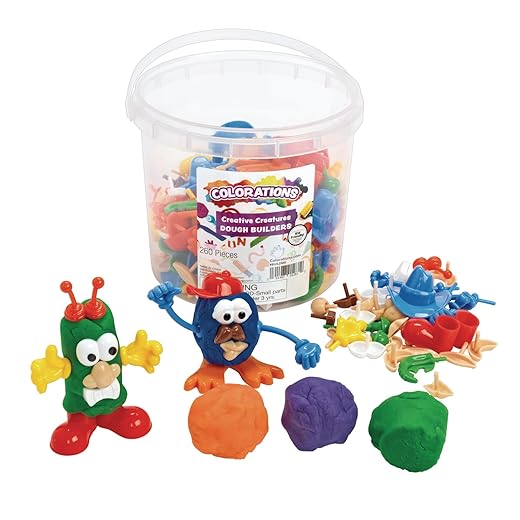
Make funny people and faces with these. Very fun toy for all ages. Dump it out on the table with ur clay or dough and just have fun. Our kids put funny voices to their crazy funny clay people. Lots of laughter at the table!!Some pieces are very small so definitely a chocking hazard for little ones. But perfect for 4 to 99 yr olds!!
Fun to use with playdoh. Fun activity for when art work is finished.